
5 days in Kagoshima, visiting 4 tea farms, 1 tea factory and the sights and sounds of the land at the foot of the majestic Mount Sukarajima, hosted by Hisae Mazda, founder of Kagoshima Farmily Tea Consortium.
Nishi Tea Factory
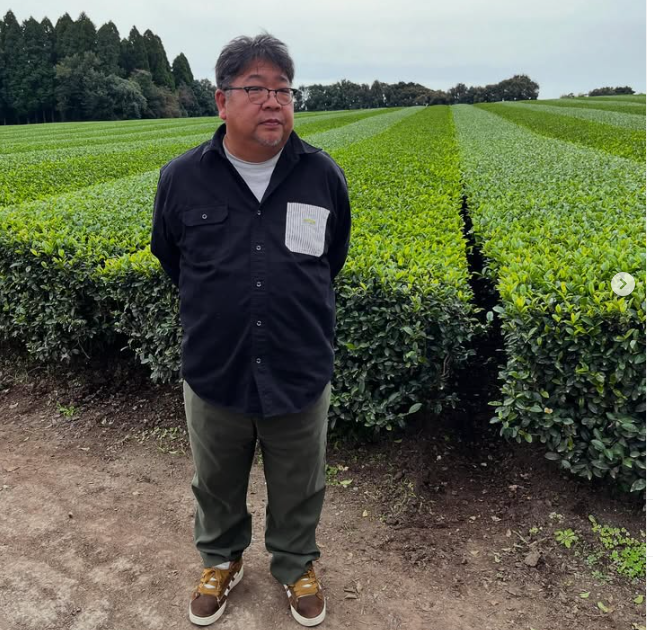
Meet The Boss. Nishi-san is not only the boss of Nishi Tea Factory @kirishima.nishicha , but his presence and influence preside over Kagoshima tea and beams all around the world. Periodically, he trots the globe heading steering committees and conferences to guide the course of one of the most important green tea prefectures in the world, one which produces just under 40% of Japan’s tea, one which is stepping up to meet the global craving for everything matcha. He is also now establishing the first ever international matcha association to help set the standards for quality of product and preparation, akin to that of the specialty coffee industry.
Big picture stuff aside, every morning he patrols his 60 hectares of tea plantation, giving direction to his team as to how best to work with nature on any given day. Paying close attention to detail is crucial in organic farming as any threat of pest infestations, changes in climatic conditions or any noticeable plant deterioration needs to be resolved swiftly to abate adverse impact on upcoming harvests.
Since his father passed the passion for tea and subsequently the care of the plantation to him as a young boy, fortunately, he does have a strong supporting cast. Upon arrival to his farm and factory, we were greeted with warm cups of matcha and fukamushi paired with sweet potato, preserved persimmon and bitter melon salad all made by Okasan and his wife. Okasan also bottles and retails her own organic goods including blueberry jam, miso paste and chilli oil.
As a first stop in our Kagoshima tea farm tour, the bar could not be set any higher than at Nishi Tea Factory. Nishi-family, thank you for your generous hospitality. Nishi-san, The Boss, hope to work with you soon.
Warmest,
アーサー・トン
Kasugaen Kawajiseicha
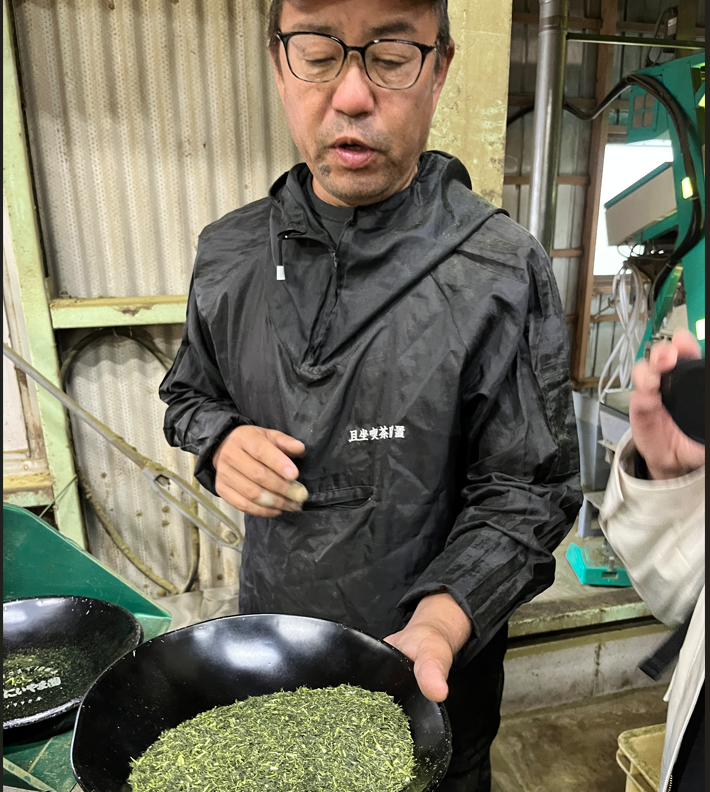
On a late Monday afternoon, we arrived at Kasugaen Kawajiseicha in the town of Ijuin, about 50 klicks southwest of Kirishima. There, a reserved yet welcoming Kawaji-san showed us around his factory and plantation. To our surprise and fascination, he was not currently processing any tea as Akibancha (autumn tea) season has just finished– he is pivoting now to organic mulberry leaf production using the EXACT same machines and processes (steaming, rolling, firing) as he would for when he makes sencha. Much of the mulberry leaf is then ground to powder producing something visually identical to matcha. Mulberry leaf is used to lower blood sugar, cholesterol and inflammation and as such, considered by some not only to be a great alternative to matcha but generally great for health. On taste, ground mulberry leaf does not have any astringency nor green tea flavour – it is subtly earthy and woody, fairly neutral on the palate.
After a brief education on mulberry leaf and a taste of the ground stuff, we didn’t have the heart to keep Itaru-san much longer as he’d had a day’s worth of harvesting and production already. So it wasn’t until the farewell night with all the other farmers that we saw him again – and on that second meeting, we saw his true colours. Once the tractors’ parked and processing machines are turned off, that is apparently when Itaru-san is turned up. Right off the bat, he showed us the ways of the Kago “Roku-yon” or the “Six-four” – 60% warm water, 40% local shochu. I’ve never kampai-ed so hard in my life. So we drank, we shabu-shabu-ed, we laughed we attempted to speak each other’s language. We were all having a great time already when Itaru-san proclaimed “second party!” and before you know it, we found ourselves (led by the party-God himself) inside a hole-in-the-wall karaoke bar belting out everything from Bon Jovi to Backstreet Boys.
Thank you for the memories Kawaji-san, you are one of a kind.
Shimokubo Seicha
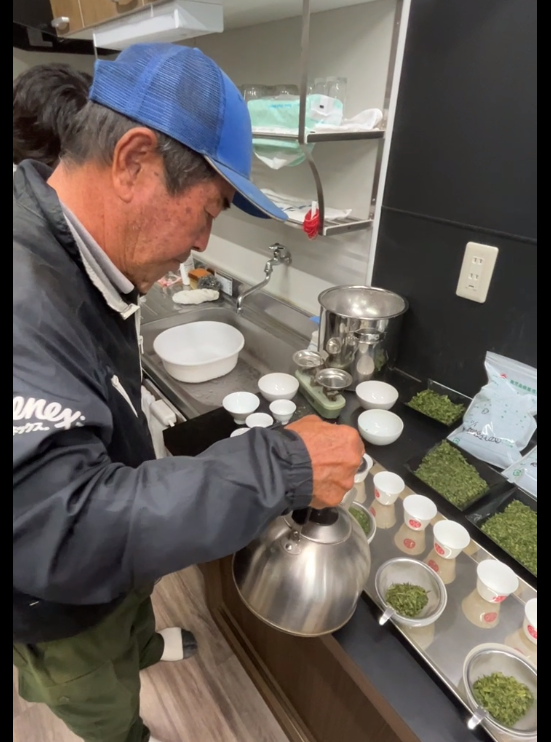
Different Japanese tea operations have varying degrees of sensitivity around what can and cannot be publicly shown. At Shimokubo Seicha, from harvest right through the copious steps of production to final bundling, it was all laid bare for us to film and publish. As his son was pulled away for a meeting, second generation grower Kazuyuki Shimokubo-san already in his 70s, hosted us through a comprehensive farm/factory tour and generously offered further time with us tasting his teas and talking shop. It was in the openness, the patience, the eyes that have seen so much that made this particular farm visit my most memorable. And let’s not forget, my moment of truth where I was the foreigner nominated by my peers to brew his prize-winning gold-standard fukamushicha (deep steamed sencha) for all, including the master himself to have as our morning tea.
Before I get to that fateful event, let’s get some context around Shimokubo Seicha. Second-gen Shimokubo-san’s father Isao was an avid tea lover and researcher. He had a deep fondness for the area’s terroir, knowing that it was blessed with the perfect tea growing conditions with its high-altitude cool nights, foggy mornings and temperate days. Beyond its natural gifts, he studied what would keep the soils rich, believing that "the basis for good tea is good soil," using rice bran as the base for compost then adding oil cake and bone meal, and lovingly maturing the composite.
The care and the love of the land continue to this day with the current second and third generation custodians. Though this carefully nurtured land has traditionally grown leaf material dedicated to sencha production, in the recent years, there has been a shift to increase production to meet the global demand for matcha. As a result, we were shown through the new government-subsidised state-of-the-art tencha production facilities while the old aracha factory languished somewhat in the backdrop.
Shimokubo-san spared no detail. He showed us how the leaves are harvested then loaded onto a little dump truck which is then driven over to unload into the factory drop-cavity just 10 metres away from the plantation. This would repeat for about 5 times a day, processing around 3 tonnes of tea leaves in total.
Unlike most other tea processing there isn’t any withering. Once the freshly harvested leaves are poured into the drop-zone, they’re spray-washed and processing begins immediately. After washing, leaves are machine tossed and dried, sifted, airjet-tossed, dried, sorted and baked and sifted again. Now depending on what grade and what style of “rough tea” is to be processed, any number of these procedures can be repeated or intensified. These are highly mechanised, elaborate processes. There are many sets of conveyors and suction chutes that transport the leaves around the factory labyrinth until they finally make it over to the packing area. Often, much of the tea that is packed then gets sent over to other companies’ facilities for further refinement e.g. shaping for sencha and milling for matcha.
Today, Shimokubo-san took a few tencha material off the line for us to taste. There was Asatsuyu, Yabukita and the newly developed Kagoshima cultivar, Seimei. His style of tea testing was straight-forward – around 2 teaspoons (approx. 4g) of tencha goes into a furui (mesh filter with a handle) which is placed inside a small chawan (tea bowl). Water right off the boil is poured in and the tencha is steeped for about 2 minutes before the furui is removed. We’re then given two tasting spoons as a means of using one for ladling and the other for tasting. Saemae was my favourite, it had a sweetness that would lend itself so well for usucha (thin) or koicha (thick) matcha drinking.
Testing tencha was one thing, but we really wanted to know what a finished Shimokubo Seicha tea tasted like. As if reading our minds, Shimokubo-san asked his staff to pass out packets of one of their award-winning fukamushicha. As we thanked him for his gift, he suggested that we should try some right there in his staff kitchen. I vaguely recall a bunch of fingers pointing my way and before you know it I was there, eye-balling dosage, temp and time like my life depended on it. There was no variable temp kettle and the scale was out of battery. So I did a touch test on their stovetop kettle, it felt around 85-90C too hot for sencha. I pulled it off the stove and poured the water into a tall glass, transferring back and forth into another, attempting to bring down the temp. Once I was satisfied, I put a tablespoon of the fukamushicha into a strainer and teapot and waited. Agitated, and waited. The colour of the brew seemed about right maybe a little on the ripe side even, so I quickly removed the strainer at which point I felt a presence over my shoulder say something in Japanese. “I normally have it a lot stronger” came the translation.
Oh no, did I just cause an international incident? Have I brought shame to my colleagues? Will I be let back into this country again?
Before crumbling to my knees, I knew I had to at least understand the extent of my misgivings. I poured myself a cup. It was in a word, delicious.
Without skipping a beat, Shimokubo-san reached for the pot, poured himself a cup. After what felt like history’s longest ever three seconds, he looked up from his cup, eyes wide scanning the room – “Oishi!”. Oh man, it was like winning the goddamn lottery. He then said he liked my brewing technique, referring to my attempts at cooling down the water. Needless to say, I was flying pretty high the rest of that afternoon.
Shimokubo-san, thank you so much for your time and for giving me a much needed pass. It was an honour to serve you.
Komaki Ryokuhouen
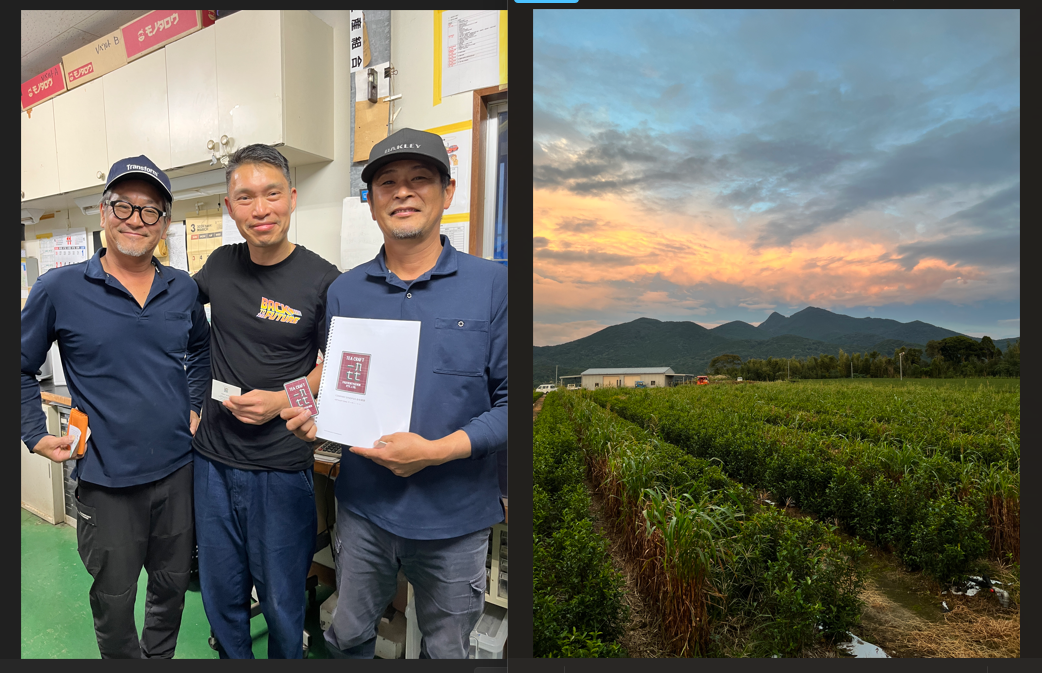
As the sun sets on a late autumn eve, the sky awash with pinks and purples creates the perfect backdrop for Sukarajima - this in turn creates the perfect backdrop for Komaki Ryokuhouen tea farms. The Komaki brothers know their blessings all too well as they shepherd us to this idyllic photo-op spot amongst rows of their gold prize winning Saemidori.
"See, this is our logo," Seigo-san laughes posing with us for the cameras with the outline of Sukarajima bearing the distinct likeness to their company brand.
It isn't difficult for me to see why my Gen X compatriots brothers Seigo and Shinya chose this life. Like the longings of another set of brothers, the fictional Lomans in Death of a Salesman, there is indeed an appeal to rejecting the corporate world we were raised to value and instead, return to nature. Though farming is perhaps the toughest of professions, the pay-off is that it is arguably the realest. So if you're going to be livin' the dream, you may as well do it amongst unrivalled natural splendour.
On this afternoon , the brothers were making moga-cha - a lesser known cousin of tencha (pre-ground matcha material). Moga-cha is less refined than tencha. Not only are the leaves harvested in autumn, they are generally unshaded with little to no de-veining or stem separation. There is also no tencha roasting process applied. The Komaki brothers are equipped to process primarily sencha materials i.e. aracha or the aforementioned pre-ground moga-cha before shipping these off to larger facilities for further refinement such as shaping and grinding.
Though Seigo and Shinya are third generation growers, Seigo mentioned to me he does not know how many more family successors there might still be. Of the two of them, his brother is the one with children and he isn't sure whether they'd like to take over the farming reigns some day. Maybe Komaki Ryokuhoen will find a way to keep the operations in the family or maybe it may be passed on to a different set of custodians. How ever the sun may set on the future succession, at least it will have a remarkable backdrop to rise to.
JA Kagoshima Chagyo
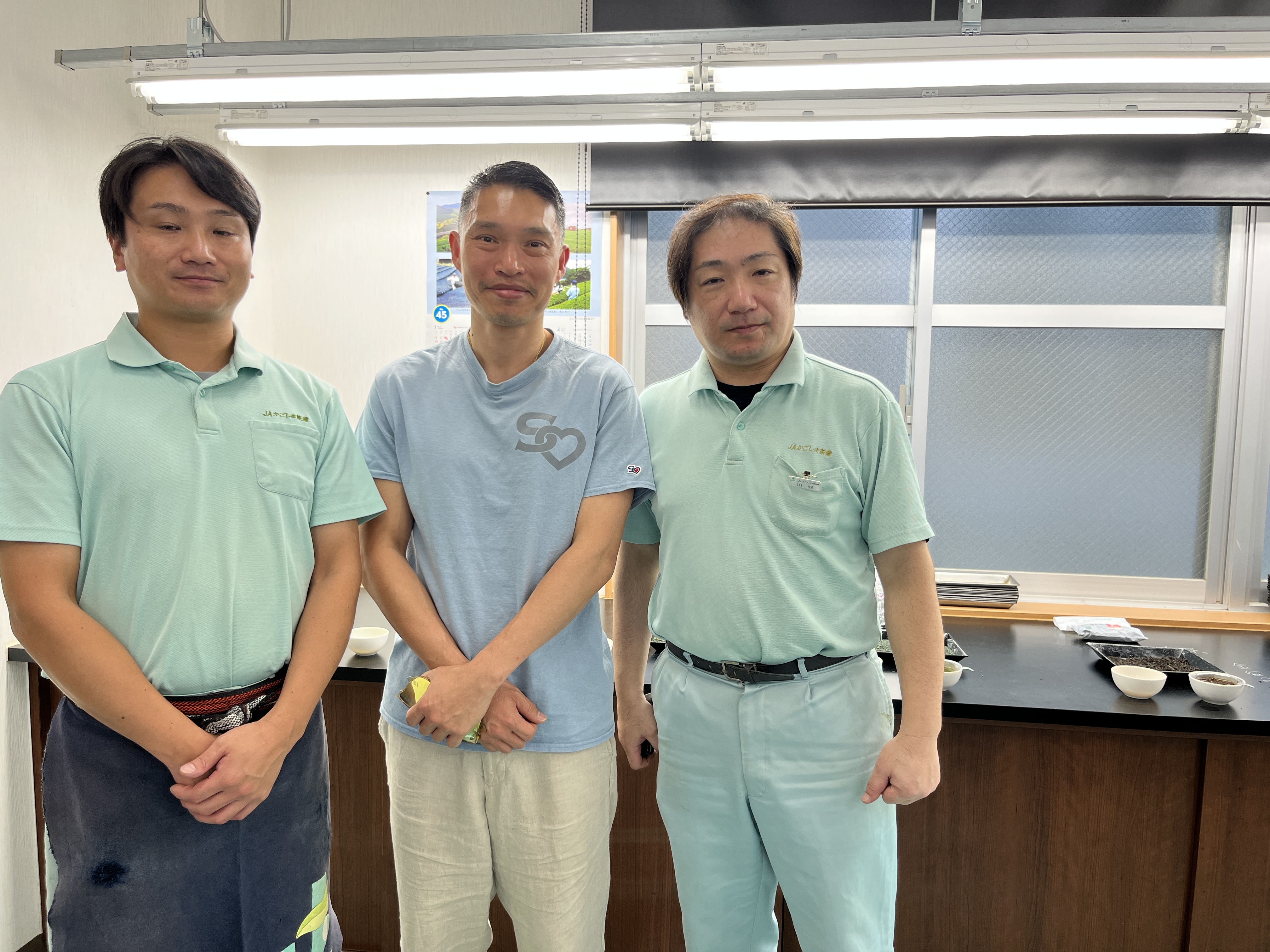
(Words to be included soon)